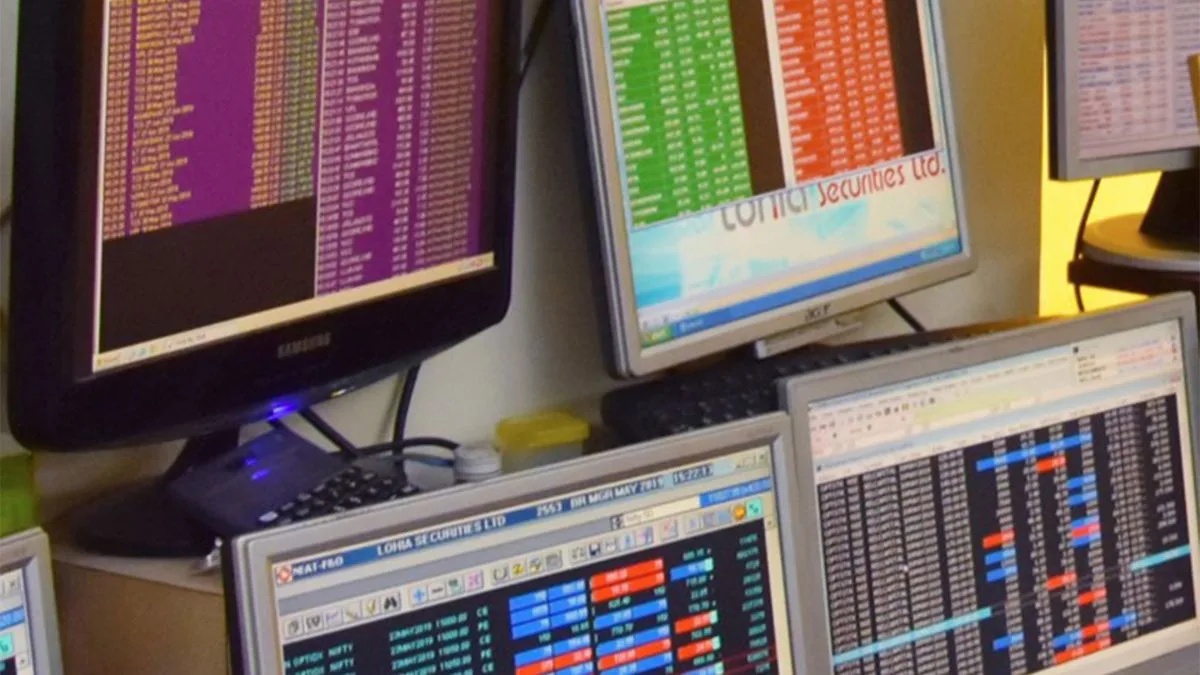
Indian stock markets opened deep in the red on Monday morning. Both benchmark indices dropped sharply within minutes of trading as investors reacted to weak global markets and a sudden spike in crude oil prices.
The decline comes as crude oil prices have shot up amid tensions in Asia. For a country like India, which imports most of its oil, the jump in prices has raised fresh worries about inflation and pressure on the economy.
Advertisement
The Nifty 50 began the session at 23,868.05, slipping 582.40 points, or 2.38 per cent, in early trade. The BSE Sensex started the session at 77,056.75, falling 1,862.15 points (2.36%), showing heavy selling across the market right from the start. The steep opening decline reflected broad-based selling across sectors on Dalal Street.
Crude oil prices surged nearly 25 per cent to about USD 116 per barrel on Monday, triggering concerns across financial markets. India imports a large portion of its energy needs, making the economy sensitive to sudden spikes in oil prices.
Ajay Bagga, banking and market expert, told news agency ANI that the sharp move in oil prices could significantly affect India’s economic indicators.
“Indian markets are seeing a huge cut in the stock futures represented by the Gift Nifty. The oil price hit to the Indian GDP, Current account deficit and inflation will be huge given that India meets more than 85 per cent of its crude oil requirements from imports,” Bagga said.
He added that higher crude prices are likely to translate into costlier fuel for consumers.
“We expect retail petrol and diesel price hikes. Cooking gas price was already hiked last week for both consumers and commercial users. Jet aviation fuel prices will also go up,” Bagga said.
According to him, sectors that rely heavily on petroleum derivatives may face additional pressure.
“Sectors like paints, aviation, autos, tyres, chemicals and all downstream industries using oil derivatives will see further cuts. However given the liquidity squeeze today, anything that can be sold will be sold, so expect cuts in leading counters, even those not correlated to the oil price, including in gold and silver,” he added.
Oil surges toward $120 as West Asia conflict deepens; Trump shrugs off spike as ‘small price to pay’
Sectoral indices slide as selling spreads across markets
Heavy selling was visible across most sectoral indices on the NSE. PSU Bank, Media and Financial Services stocks were among the worst affected.
The Nifty Auto index dropped 2.9 per cent, while Nifty Media declined 2.36 per cent. The PSU Bank index plunged 4 per cent, while Nifty IT slipped 1.29 per cent. Nifty FMCG fell 1.38 per cent, and the Consumer Durables index lost around 2 per cent.
Sunil Gurjar, SEBI-registered analyst and Founder of Alphamojo Financial Services, said weak technical signals had already begun to emerge.
“The Nifty 50 had a weak week. The index also breached the important 200-EMA, while a bearish EMA crossover indicates weakness in the trend. The fall was mainly driven by heavy FII selling, a weakening rupee, and ongoing global war tensions, which hurt market sentiment,” he said.
Gurjar said the market may stabilise if the index crosses 24,646, which could indicate renewed bullish momentum. However, if it slips below current support levels, further downside could follow. He added that 23,850 remains another crucial support zone for the index.
Asian markets tumble as global sentiment weakens
The decline in Indian equities mirrored losses across other Asian markets.
Japan’s Nikkei 225 dropped about 7 per cent to the 52,010 level, while South Korea’s KOSPI index plunged 7.43 per cent to around 5,169.
Elsewhere in Asia, Singapore’s Straits Times index fell 2.65 per cent to about 4,720, Hong Kong’s Hang Seng index slipped over 2.46 per cent to around 25,095, and Taiwan’s weighted index declined 5.77 per cent to approximately 31,767.
US markets had already ended last week on a weak note. On Friday, the S&P 500 fell 1.33 per cent to about 6,740, while the Nasdaq slipped 1.53 per cent to around 22,400, reflecting growing investor caution globally.